How to read a synastry chart: the order I go through two charts
8-minute read · 6 sections

Fifty aspects between two charts is not a reading, it is a pile. What turns it into one is a fixed order: cast both charts correctly, read the tightest personal contacts first in both directions, and leave the wide and the generational ones for last. That is my routine for every synastry chart, run here on one example pair.
The pair we will read
Sam and Lena are invented, but their charts are real calculations, checked against Swiss Ephemeris. Type them into the synastry chart calculator and follow along.
| Person | Birth place | Local time | Zone for that moment |
|---|---|---|---|
| Sam | Chicago | 4 July, 09:15 | UTC−5 (summer time) |
| Lena | Madrid | 8 April, 21:40 | UTC+2 (summer time) |
Each chart has 13 points: ten planets, the mean North Node, the Ascendant and the Midheaven. Every point of Sam's meets every point of Lena's, which makes 169 pairs. Fifty fall inside the orbs below; seven of those are generational contacts I set aside.
Step one: get both charts right before you read anything
A synastry reading inherits every error in the two charts under it, and the commonest error is the clock. Take the local time from the birth certificate, then check whether summer time applied that day. Sam's July morning in Chicago was UTC−5, not UTC−6; Lena's April evening in Madrid was UTC+2, not UTC+1.
The sky turns about 1° every 4 minutes, so one forgotten hour moves the Ascendant by 10–15°. Enter Lena as UTC+1 and her Ascendant lands in Scorpio 12°11' instead of Scorpio 0°23', and her Midheaven in Leo 21°01' instead of Leo 5°59'. It also invents contacts: Sam's Sun would trine her Ascendant to 0°38'. The calculator reads the offset from the browser's copy of the IANA time-zone database, resolves summer time for each birth moment and shows it as "UTC−5 (summer time)". For older births that database is less reliable, so double-check the offset.
Step two: fix your orbs and let tightness do the ranking
An orb is how far from exact an aspect may be and still count. I allow wide orbs between planets and tighter ones for the angles and the Node, because the angles swing a degree every few minutes and the Node is a point, not a body.
| Aspect | Planet to planet | With Ascendant, Midheaven or Node |
|---|---|---|
| Conjunction | 8° | 5° |
| Opposition | 8° | 5° |
| Trine | 7° | 4° |
| Square | 7° | 4° |
| Sextile | 5° | 3° |
| Quincunx | 2° | 1° |
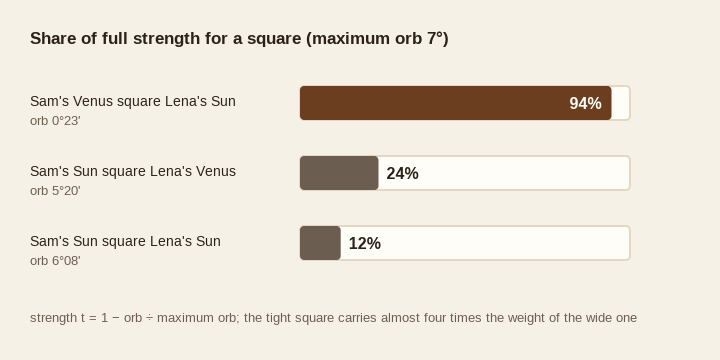
Inside those limits, tightness decides how loud a contact is: t = 1 − orb ÷ maximum orb. Sam's Venus square Lena's Sun is 0°23' from exact, so t = 1 − 0.39 ÷ 7 = 0.94 and it keeps 94% of its strength. Their Suns are square too, but 6°08' out, and that one keeps 12%. One tight square between personal planets says more than ten wide sextiles.
Step three: read every contact in both directions
"Sam's Venus square Lena's Sun" and "Sam's Sun square Lena's Venus" are two different contacts: the first is 0°23' from exact, the second 5°20'. Some calculators list each pair of planets once, which quietly deletes half the information. This one runs every point of the first chart against every point of the second and never merges them.
Whose planet is whose matters too. Sam's Venus pressing on Lena's Sun reads as the way Sam shows affection meeting Lena's sense of who she is, with friction at the point of contact. Swap the owners and the sentence changes meaning.
The order I read the contacts in
1. Venus and Mars
I start with Venus, as Café Astrology also advises, because it shows what each person finds attractive, then Mars for desire and drive. Sam's Venus makes seven contacts to Lena's chart, four of them to her personal planets: square her Sun (0°23'), trine her Moon (1°21'), trine her Mercury (2°53') and conjunct her Mars (2°53'). Lena's Venus gets a trine from Sam's Mercury (1°22') and a wider square from his Sun (5°20').
People ask whether Venus conjunct Mars is a good sign. It is intense: attraction and friction in one breath. The calculator labels it intense and gives it a contribution of 0: it adds to the intensity figure but to neither the harmony nor the tension side, because a conjunction only counts as easy when both points are on the gentler list (Sun, Moon, Mercury, Venus, Jupiter, the angles, the Node), and Mars is not.
2. Sun and Moon
Sun–Moon contacts, in either direction, are the classic "we fit" contacts: identity meeting emotional needs. This pair has exactly one, Sam's Sun trine Lena's Moon at 4°23', comfortable but fairly wide (t = 0.37). Sam's Moon makes no aspect at all to Lena's chart inside these orbs, and an empty row is information too.
3. The Moon contacts
The Moon decides whether two people feel at home together, so I read all its contacts at once. Lena's Moon is the busiest column in the aspect grid, with eight contacts (Sam's Moon row, by contrast, is empty):
| From | Aspect | Orb |
|---|---|---|
| Sam's Saturn | Square | 0°11' |
| Sam's Neptune | Sextile | 0°28' |
| Sam's Uranus | Sextile | 1°03' |
| Sam's Venus | Trine | 1°21' |
| Sam's Mars | Opposition | 2°44' |
| Sam's Pluto | Conjunction | 3°06' |
| Sam's Midheaven | Opposition | 4°09' |
| Sam's Sun | Trine | 4°23' |
The tightest is Saturn: seriousness pressing on her feelings, which can feel like being measured or like being looked after, depending on the day. The Moon also depends most on the birth hour: it moves about 13° a day, as the Astrology Podcast explains. With Lena's time unknown, her Moon could be anywhere from Scorpio 4°00' to Scorpio 18°37' that day, and the calculator flags every Moon contact that changes during the day as depending on birth time. Contacts that form only at some other hour go into a separate "Possible at other hours" list.
4. Mercury
Mercury is conversation, and here it is friendly: Sam's Mercury sextile Lena's Jupiter (0°15') and trine her Venus (1°22'), Sam's Venus and Pluto trine her Mercury (2°53' and 1°07'), and Sam's Midheaven sextile it (0°04'). Nothing hard touches Mercury, so the Mind score is 100, which means no tense Mercury contacts, not "they will never argue".
5. Saturn
Saturn is the commitment planet, the glue that can also feel heavy. Besides the square to her Moon, Sam's Ascendant opposes Lena's Saturn (0°36'), and Sam's Saturn sextiles her Sun (1°32') and her Node (2°11'). The long-term score is 30, because the heavy contacts outweigh the supportive ones. For me that shows where the work sits, not whether the pair will last.
6. Angles and the Node
Contacts to the Ascendant and Midheaven describe first impressions and the public side of a relationship, and exist only when the birth time is known. Sam's Midheaven sextiles Lena's Mars and Mercury (both 0°04') and trines her Neptune (0°17') and Uranus (0°40'); his Node sextiles her Ascendant (0°25'). The Midheaven moves about a degree every 4 minutes, so a 0°04' contact is only as exact as the birth time.
7. What I skip: generational contacts
Uranus, Neptune and Pluto move only a few degrees a year, so two people born within a few years of each other share their outer-planet contacts. This pair has seven: Neptune–Neptune (3°23'), Pluto–Pluto (4°43'), Uranus–Uranus (5°53'), Neptune–Uranus both ways (4°21' and 4°55') and two sextiles from Pluto to Neptune and Uranus (0°45' and 1°43'). They describe a generation, not a couple, so the calculator greys them out and scores them zero. An outer planet touching a personal one is different: Sam's Pluto trine Lena's Mars (1°07') counts in full.
8. Overlays and the composite last
Only then do I look at where each person's planets fall in the other's houses (see synastry house overlays) and at the midpoint chart (composite chart vs synastry). They add context; they do not overrule a tight contact.
The harmony score is a summary, not a verdict
The calculator turns the contacts into one number for a quick view of the balance. Each aspect gets a contribution c = nature × weight × t. Nature is +1 for a trine, +0.7 for a sextile, −1 for a square, −0.7 for an opposition, −0.3 for a quincunx. Weight is 2 when both points are personal (Sun, Moon, Venus, Mars, Ascendant), 1.5 when one is, 1 when neither is.
Add up the positive contributions (H = 15.40 here) and the negative ones (N = 11.89), and the score is 100 × H ÷ (H + N) = 100 × 15.40 ÷ 27.29, which rounds to 56. Websites differ because each invents its own weights; here the five biggest contributions are listed, so you can disagree with them.
Things people ask
What are the most important aspects in synastry?
Tight contacts between personal planets come first: Venus, Mars, the Sun and the Moon, then Saturn and the angles. One square at 0°23' between personal planets outweighs several sextiles at 5°.
What orb should I use for synastry aspects?
I use 8° for conjunctions and oppositions, 7° for trines and squares, 5° for sextiles and 2° for quincunxes between planets, and 5°, 4°, 3° and 1° when the Ascendant, Midheaven or Node is involved.
Is Venus conjunct Mars in synastry a good sign?
It is intense rather than easy or hard: attraction and friction together. This calculator marks it intense with a score contribution of 0, so it counts toward neither harmony nor tension; read it alongside the rest of the chart.
Do I need an exact birth time for synastry?
For planet-to-planet aspects the date and place are enough, except for the Moon, which moves about 13 degrees a day. The Ascendant, Midheaven and house overlays need the birth time.
Why do two websites show a different synastry score?
Each one chooses its own orbs and weights. Here the rule is open: contribution = nature × weight × tightness, so you can follow every step from the aspects to the number.

