Composite chart vs synastry: midpoints, Davison and when to use each
7-minute read · 6 sections

Two charts on one table is synastry. One chart built out of the two is a composite. They answer different questions, and mixing them up is how people end up reading "their Venus" in a wheel that contains nobody's Venus at all.
Three ways to chart a pair
When a site says "relationship chart", it can mean any of three things. I keep them apart like this:
| Compared | Synastry | Composite (midpoint) | Davison |
|---|---|---|---|
| What it is | Two natal charts compared, aspects and houses across them | One chart; each point is the midpoint of the partners' same point | One chart cast for the midpoint in time and in place |
| Question it answers | How do we affect each other? | What is the relationship itself like? | The same, in a chart with a real sky |
| Birth times needed | For angles, houses and the Moon | Planets: not really; angles: both | Both, with both places |
| In this calculator | Yes: grid, list, overlays | Yes: Composite tab | No, explained here only |
The Composite tab of the synastry chart calculator builds the middle column. Sam and Lena's synastry, covered in how to read a synastry chart, tells you that his Venus squares her Sun at 0°23'. A composite tells you nothing about who does what to whom. It describes the pair as a third entity with its own Sun, Moon and Ascendant.
How the midpoint is calculated
Take Sam's Sun at 102.8379° (Cancer 12°50') and Lena's at 18.9758° (Aries 18°58'). Their plain average is 60.9°, which happens to be the right answer here, but averaging fails as soon as two points straddle 0° Aries. Between any two points on a circle there are two midpoints, 180° apart. The composite method takes the one on the shorter arc:
For the two Suns: d = ((18.9758 − 102.8379 + 180) mod 360) − 180 = 96.1379 − 180 = −83.8621, so m = 102.8379 − 41.9311 = 60.9068°, which is Gemini 0°54'. The shorter arc between them is 83.86°, and the composite Sun sits halfway along it.
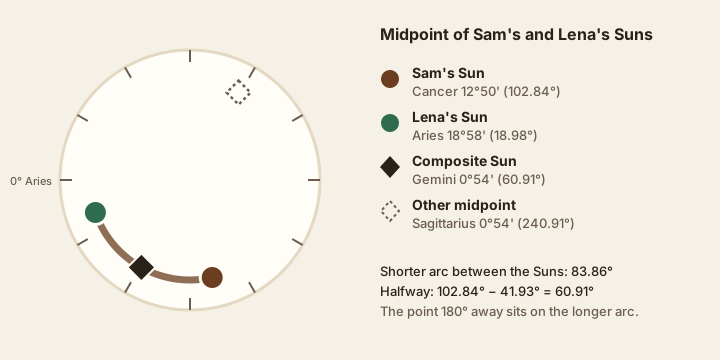
Three small cases show where programs go wrong:
| Points | Shorter-arc rule | Result |
|---|---|---|
| 350° and 20° | d = 30°, m = 350° + 15° | 5° = Aries 5°00' (a plain average gives 185°, Libra 5°, the wrong half of the wheel) |
| 170° and 350° | exactly opposite: d = −180°, m = 170° − 90° | 80° = Gemini 20°00' |
| Sam's Moon Virgo 9°32' and Lena's Moon Scorpio 17°13' | d = 67.69° | Libra 13°23', a sign neither of them has the Moon in |
The exactly-opposite case is a genuine tie, since both midpoints are equally far from each point. This calculator chooses the one 90° behind the first point, and another program may choose the other, so such a composite planet can differ between tools. It is rare, and it deserves a note rather than a worry.
Sam and Lena's composite
| Point | Sam | Lena | Composite |
|---|---|---|---|
| Sun | Cancer 12°50' | Aries 18°58' | Gemini 0°54' |
| Moon | Virgo 9°32' | Scorpio 17°13' | Libra 13°23' |
| Mercury | Leo 8°52' | Pisces 21°28' | Gemini 0°10' |
| Venus | Cancer 18°34' | Aries 7°30' | Taurus 28°02' |
| Mars | Taurus 14°29' | Cancer 21°27' | Gemini 17°58' |
| Ascendant | Leo 27°56' | Scorpio 0°23' | Virgo 29°10' |
| Midheaven | Taurus 21°23' | Leo 5°59' | Gemini 28°41' |
The composite angles are midpoints of the two Ascendants and the two Midheavens, so they need both birth times; with either one missing the calculator gives composite planets only. The composite Ascendant and Midheaven are midpoints of angles cast at different places and times, so they do not describe a real horizon; I read them as the way the relationship presents itself, not as a literal rising sign. This calculator shows composite positions, angles and aspects, and I do not read composite houses from it.
Timing matters for the Moon. If Lena's birth time were unknown, her Moon would range over about 14.6° during that day, and the composite Moon, being halfway, would range over about 7° of it. With an unknown time the Composite tab shows the composite Moon as a range for the day, and I read it by sign tendency only.
Reading a composite without fooling yourself
Some composite aspects look dramatic and are nearly automatic. Here are the tightest ones for Sam and Lena, with how much weight I give each:
| Aspect | Orb | How I weigh it |
|---|---|---|
| Saturn sextile Node | 0°13' | Modest: both are slow movers, so it repeats for couples born in similar years |
| Uranus conjunct Neptune | 0°17' | Generational: skip |
| Saturn square Pluto | 0°19' | Slow planets again; light weight |
| Ascendant square Midheaven | 0°28' | Near-automatic: skip |
| Sun conjunct Mercury | 0°44' | Structural, but worth explaining |
| Mercury trine Ascendant | 0°59' | Meaningful: how the pair talks and presents itself |
| Venus trine Ascendant | 1°07' | Meaningful: liking is easy to show |
The two "automatic" ones are worth understanding. In a typical natal chart the Ascendant sits roughly a quarter circle from the Midheaven (96.6° apart for Sam, 84.4° for Lena), and averaging two such pairs lands even closer to 90°, so a composite Ascendant–Midheaven square is common and I read nothing into it. Likewise Mercury never strays more than about 28° from the Sun, and Venus never more than about 47°, so their composite Sun–Mercury or Sun–Venus pairs are close by construction. Sam's Mercury runs 26° ahead of his Sun and Lena's runs 27.5° behind hers, and the two almost cancel, which is why the composite conjunction is as tight as 0°44'.
That leaves the contacts I would actually talk about: the Sun, Mercury and Venus all trine the composite Ascendant (1°43', 0°59' and 1°07'), a simple, warm pattern with no friction in it. Notice also that the composite Sun and Mercury both fall at the very beginning of Gemini, and Venus ends Taurus, so the relationship chart reads as talkative and sociable.
The Davison chart in brief
The Davison relationship chart takes the midpoint in time of the two birth moments and the midpoint of the two birth places, and casts an ordinary chart for that moment. Sam and Lena were born about 278 days apart, so the Davison moment falls roughly four and a half months after Sam's birth, in late autumn. The midpoint of Chicago and Madrid by latitude and longitude is about 41.1°N, 45.7°W, which is the open North Atlantic. The houses are cast for that spot on the ocean.
Because it is a real sky, a Davison chart never shows an impossible Mercury 40° from the Sun, and its houses are genuine. That is the argument in its favour, and it is the reason some astrologers prefer it for timing work. The argument against it: it is a chart for a moment at which neither person was born. This calculator builds only the midpoint composite, but you will meet Davison charts elsewhere, so keep the two names apart.
When I use which
- Start with synastry. It shows who triggers what, in both directions (the houses are covered in synastry house overlays), and fits dating and the early stages best. Without it a composite is just a pretty wheel.
- Add the composite once the contacts are clear. It suits long relationships, marriages, business partnerships and friendships, where the question is what the pair is for and how it presents itself.
- Look at Davison only when you want a real sky. It is the version people use for timing, because its planets move the way planets do.
- Let a contradiction slow you down. When the composite Moon looks gentle and the synastry Moon contacts look tense, I do not pick one. Both can be true: the pair presents one way and rubs in another.
None of the three is a verdict. Carl Jung compared the horoscopes of more than 400 married couples and found no causal explanation for the correlations he saw, according to Wikipedia's article on synastry. I take that seriously: the charts work as prompts for a conversation, a vocabulary for differences, not as a forecast.
Things people ask
What is the difference between a composite chart and synastry?
Synastry keeps two natal charts and reads the aspects and houses between them. A composite makes one new chart in which every point is the midpoint of the partners' same point.
How is a composite chart calculated?
Each planet is placed halfway along the shorter arc between the partners' two longitudes: m = a + d ÷ 2, where d = ((b − a + 180) mod 360) − 180. Exactly opposite points are a tie, resolved by convention.
What is a Davison chart?
A chart cast for the midpoint in time and in place of the two birth moments. It has a real sky and real houses, unlike a midpoint composite. This calculator does not build it.
Do I need both birth times for a composite chart?
For composite planets the dates and places are enough, though the Moon is uncertain without a time. The composite Ascendant and Midheaven need both birth times.

